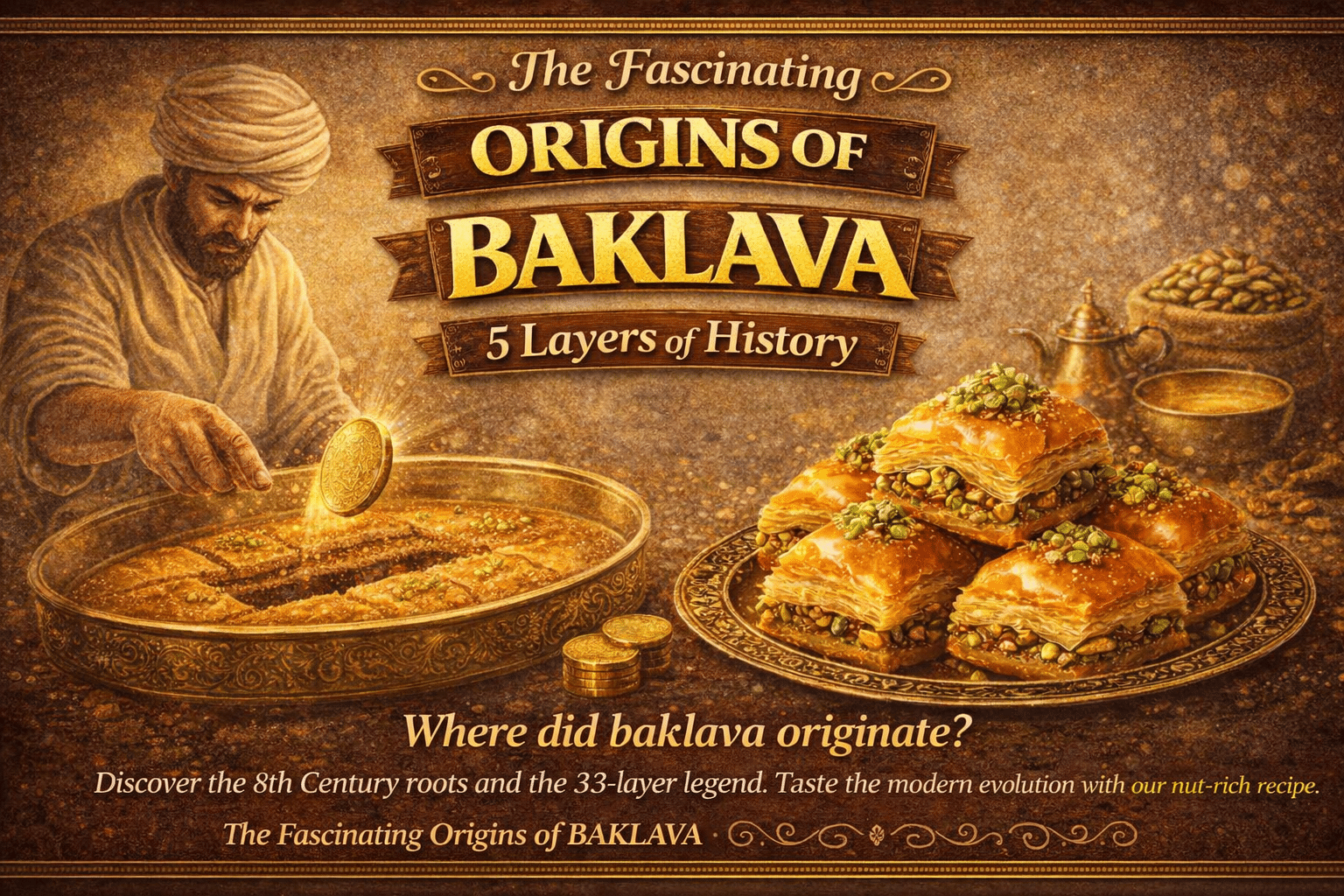
Did you know that in the Ottoman royal courts, a master baker’s entire career could depend on a single gold coin?
Legend has it that the Sultan would test a fresh tray of Baklava by dropping a gold coin from a height. If the layers were not crisp and thin enough for the coin to slice through and hit the bottom of the pan, the dessert was rejected as “too heavy”, and the baker was in big trouble.
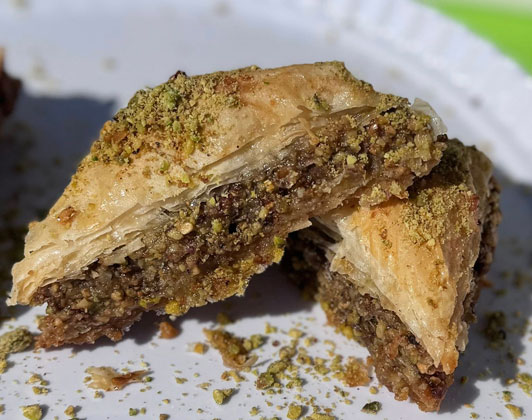
Today, at A Lil Baklava, we don’t use gold coins to test our pastry, but we carry that same obsession with the perfect crunch.
Welcome to The Fascinating Origins of Baklava. This is a story that is as rich, complex, and layered as the dessert itself.
The Ancient Roots (8th Century BC)
Long before there were ovens in every home, the ancient Assyrians were already experimenting as far back as the 8th Century BC. They did not have the paper-thin dough we use today. Instead, they layered unleavened bread with chopped nuts and drenched it in honey. It was rustic and hearty. This early version is the great-grandfather of the treat we adore today.
Is Baklava Polish or Greek? The Innovation of the Leaf
As history moved forward, travelers and merchants carried recipes across borders. This leads to some confusion today. Some customers ask is baklava Polish or Greek? While Poland has its own delicious filled pastries, the specific innovation of baklava belongs to the Mediterranean.
We owe a huge debt to ancient Greek bakers. They were the ones who revolutionized the dough. They created a technique to roll it as thin as a leaf. In fact, the word “Phyllo” actually means “Leaf” in Greek. Without this innovation, we would not have that delicate crunch that customers love in our Shop.
The Ottoman Perfection: A Ramadan Tradition
While the Greeks gave us the leaf, the Ottoman Empire gave us the refinement. In the Topkapi Palace kitchens in Istanbul, baking became a high art.
This answers a very common question: Can Muslims eat baklava? Absolutely. In fact, baklava is deeply tied to Islamic traditions.
There is a legendary historical event known as the “Baklava Procession” or Baklava Alayı. On the 15th of Ramadan, the Sultan would present trays of Baklava to his elite soldiers, the Janissaries. It was a symbol of power, respect, and celebration. Since the ingredients are pure, natural, and Halal, it remains a staple sweet for Eid and Ramadan celebrations worldwide.
Some historical accounts suggest that in the past, Baklava was baked with 33 layers to represent the 33 years of Christ’s life. Or sometimes 40 layers during Lent. This proves that this dessert has always crossed religious and cultural borders.
The Great Debate: Turkish, Iranian, or Greek?
So, is baklava Turkish or Iranian? Or is it Greek? And which baklava is better, Greek or Turkish?
Here is the truth. It is a blend.
- The Persian Touch: The diamond cut we use today likely comes from Persian artistry. They also introduced the aroma of jasmine and rosewater.
- The Greek Style: Typically uses honey, walnuts, and cinnamon.
- The Turkish Style: Often uses sugar syrup, pistachios, and lemon juice.
When people ask me what country makes the best baklava, I tell them that the best baklava is the one made with love and precision. It is the one that balances all these histories in one bite.
How to Eat Baklava Like a Pro
We have talked about history. Now, let us talk about enjoyment. Did you know there is a “right” way to eat baklava?
Many people just bite into it. But here is a trick I learned from the masters.
Turn it upside down.
Yes. Really. The bottom part of the pastry holds the most syrup. When you flip it before taking a bite, that sweet buttery layer hits the roof of your mouth first. It enhances the flavour profile instantly.
Also, pair it wisely.
Because Baklava is rich, it needs a strong partner.
- Black Coffee or Espresso: The bitterness cuts through the sweetness perfectly.
- Mint Tea: A classic pairing that refreshes the palate.
- Vanilla Ice Cream: If you are trying my Baklava Cheesecake, a scoop of vanilla creates the ultimate hot-and-cold dessert experience.
Here is a secret that will save your dessert. Never put Baklava in the fridge. From a chemistry perspective, cold temperatures accelerate ‘sugar crystallisation,’ which turns the smooth syrup into grainy crystals and makes the crispy layers chewy and tough. Real Baklava is designed to live at room temperature; just keep it airtight, and it will stay crisp for days.
The Nurse’s Perspective: Evolution in the Kitchen
Why do I care so much about this history? Because, as a nurse, I respect procedures. The history of Baklava is basically thousands of years of humans perfecting a procedure.
However, I noticed that history often left one problem. Sugar Overload.
In the past, honey and sugar were preservatives, so they drenched the pastry in them. Today, we have fridges! We do not need to preserve it for months. We need to enjoy it now.
That is why A Lil Baklava is the next step in this history:
- The Crunch Ratio: I respect the Ottoman thin layers, but I defy the tradition of nut dust. I use thick, generous chunks of nuts.
- The Sweetness Balance: I adjusted the syrup to be a companion and not a dominator. You taste the nuts, the butter, and the pastry first.
- The Modern Twist: History never stops. By creating Baklava Cheesecake, I am adding a new layer to this 3,000-year-old story.
A Final Thought from My Kitchen
When you bite into a piece of Baklava, you are not just eating dessert. You are tasting the Assyrian honey, the Greek dough, the Ottoman precision, and the Persian aroma.
With A Lil Baklava, you get all of that history plus a nurse’s dedication to perfection and a mother’s love.
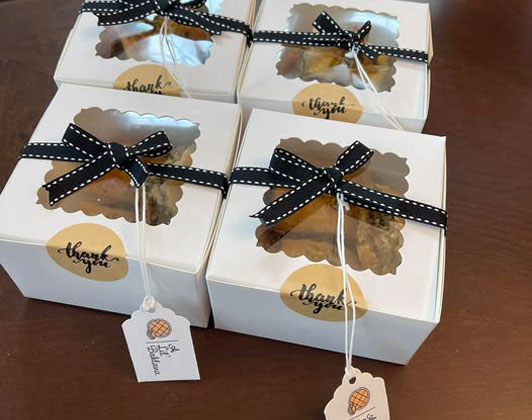
Want to taste history without the sugar crash? Order Your Box Now